
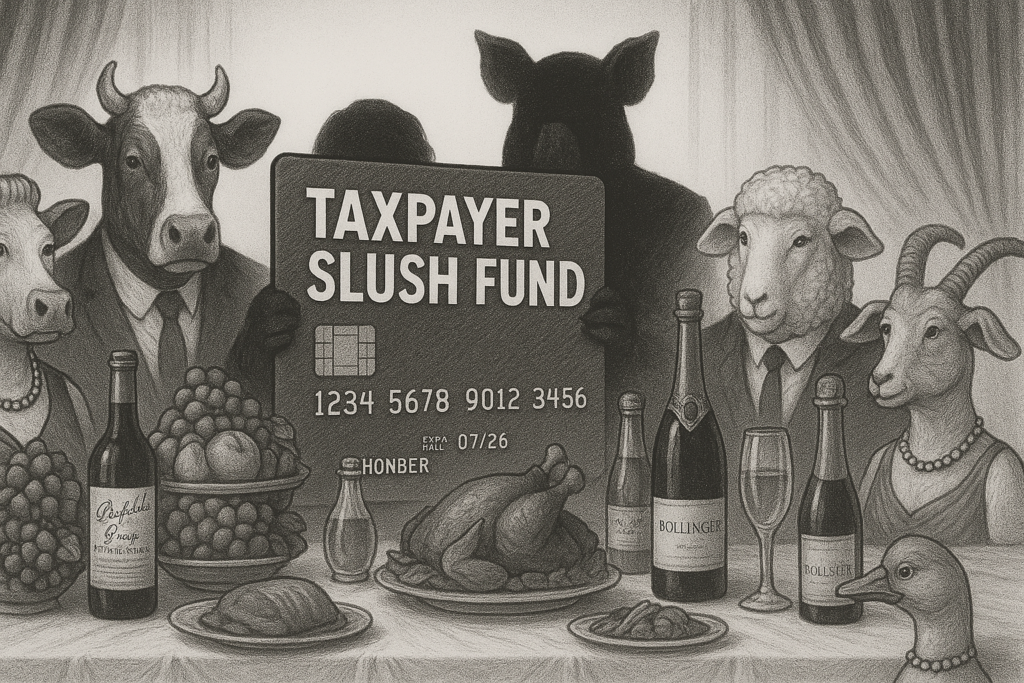
While pensioners shiver through winter because they can’t afford heating, while families ration groceries to make rent, and while young Australians abandon the dream of homeownership, some of our elected representatives appear to glide above these pressures—comfortably insulated by taxpayer-funded perks.
Recent revelations involving Communications Minister Anika Wells, who enjoyed taxpayer-funded lunches and extensive flights while dismissing scrutiny of the very system she was exploiting, are only the latest example. The spectacle of a minister publicly mocking concerns about politically funded dining—while privately dining at the public’s expense—is not merely tone-deaf. It is emblematic of a political class that has forgotten who it serves.
And while the Prime Minister himself, Anthony Albanese, refuses to tighten the rules or reform the Parliamentary Business Resources Act 2017, the message is unmistakable: the political elite will protect its entitlements before protecting Australians from the cost-of-living crisis.
This is not representation.
This is self-preservation dressed up as governance.
The PBR Act: A Convenient Shield for Expensive Habits
The Parliamentary Business Resources Act 2017 (PBR Act) was supposed to deliver accountability. Instead, its vague principles—like “dominant purpose” and “value for money”—have become a smokescreen behind which ministers justify everything from luxury lunches to interstate family travel.
When confronted, they reply with the same old robotic phrase:
“I acted within the rules.”
But Australians are not asking whether ministers can technically tick a box on a compliance form. They are asking whether their elected leaders have any sense of moral responsibility, any instinct for the struggles of ordinary families, or any appreciation of what taxpayers actually sacrifice to fund government.
When the law becomes a loophole, and the loophole becomes a lifestyle, democracy becomes a farce.
Anika Wells: The Poster Child for Political Entitlement
The Wells controversy has become a lightning rod for public fury, not because of the dollar figures alone, but because of the arrogance behind them.
Here is a minister who:
- Mocked concerns about taxpayer-funded lunches…
- While simultaneously enjoying taxpayer-funded lunches;
- Claimed her lavish travel complied with the PBR Act;
- And then referred herself to IPEA only after public exposure forced her hand.
This is behaviour we expect from a protected aristocracy, not from an elected representative in a modern democracy.
Her actions send a blunt message:
The rules are flexible for the powerful, but rigid for the public.
Anthony Albanese: Protecting the System Instead of Fixing It
When a Prime Minister refuses to reform obviously broken rules, it is not ignorance—it is a choice.
Anthony Albanese’s defence of the existing PBR framework, even amidst escalating scandals, suggests a government more committed to managing optics than to restoring integrity. If a minister can spend with impunity while Australians sink under inflation, and the Prime Minister refuses to change a single provision of the system that enables it, then Canberra has ceased to understand Australia.
Leaders do not merely follow the rules.
Leaders set the standard.
And right now, the standard is embarrassingly low.
The Two Australias: The Political Class vs the Public
Australia has become a tale of two nations:
1. Ordinary Australians
- Pensioners counting coins at the checkout.
- Families cancelling holidays and school activities.
- School leavers working two jobs just to pay rent.
- Young couples realising the property market has locked them out indefinitely.
2. Politicians under the PBR Act
- Flying interstate on the public purse.
- Dining out in style while mocking concerns about “taxpayer-funded lunches.”
- Defending luxury expenses with bureaucratic jargon.
- Talking about “public service” while living like a cosseted elite.
This contrast is repugnant to the Australian sense of fairness.
The political class may not see it—but Australians do.
Public Money Deserves Public Morality
Nothing erodes trust faster than hypocrisy, and nothing breeds hypocrisy faster than entitlement. When ministers consume taxpayer resources with the ease of a corporate expense account, they forget that every dollar represents the toil of a citizen—someone who does not have the luxury of claiming rent or petrol as a “work expense.”
Public office is not a reward.
It is not a lifestyle subsidy.
It is not a pathway to elite comfort.
It is a sacred trust.
And too many in Canberra are treating it like a personal privilege.
It’s Time for a Reckoning, Not Another Review
Real accountability will not come from another committee or another “review of the rules.” It will come from decisive reforms:
- Stricter definitions of what counts as “parliamentary business.”
- A ban on non-essential family travel at public expense.
- Public release of itemised expenses within 30 days.
- Independent audits with teeth—not polite recommendations.
- A mandatory code requiring ministers to meet community standards, not internal political expectations.
If politicians cannot meet the ethical bar set by ordinary Australians, they have no business standing for office.
Australians Deserve Leaders, Not Lords and Ladies
There is a word for politicians who treat public money as their own:
entitled.
There is another word for politicians who enrich themselves while their citizens suffer:
unfit.
Australians deserve better than a ruling class that thinks compliance equals integrity. They deserve representatives who share their burdens, not exploit their taxes.
Until politicians, all too willing to defend the status quo, see this, the public will continue to view Canberra as a gated community of elites.
And they will be right...