
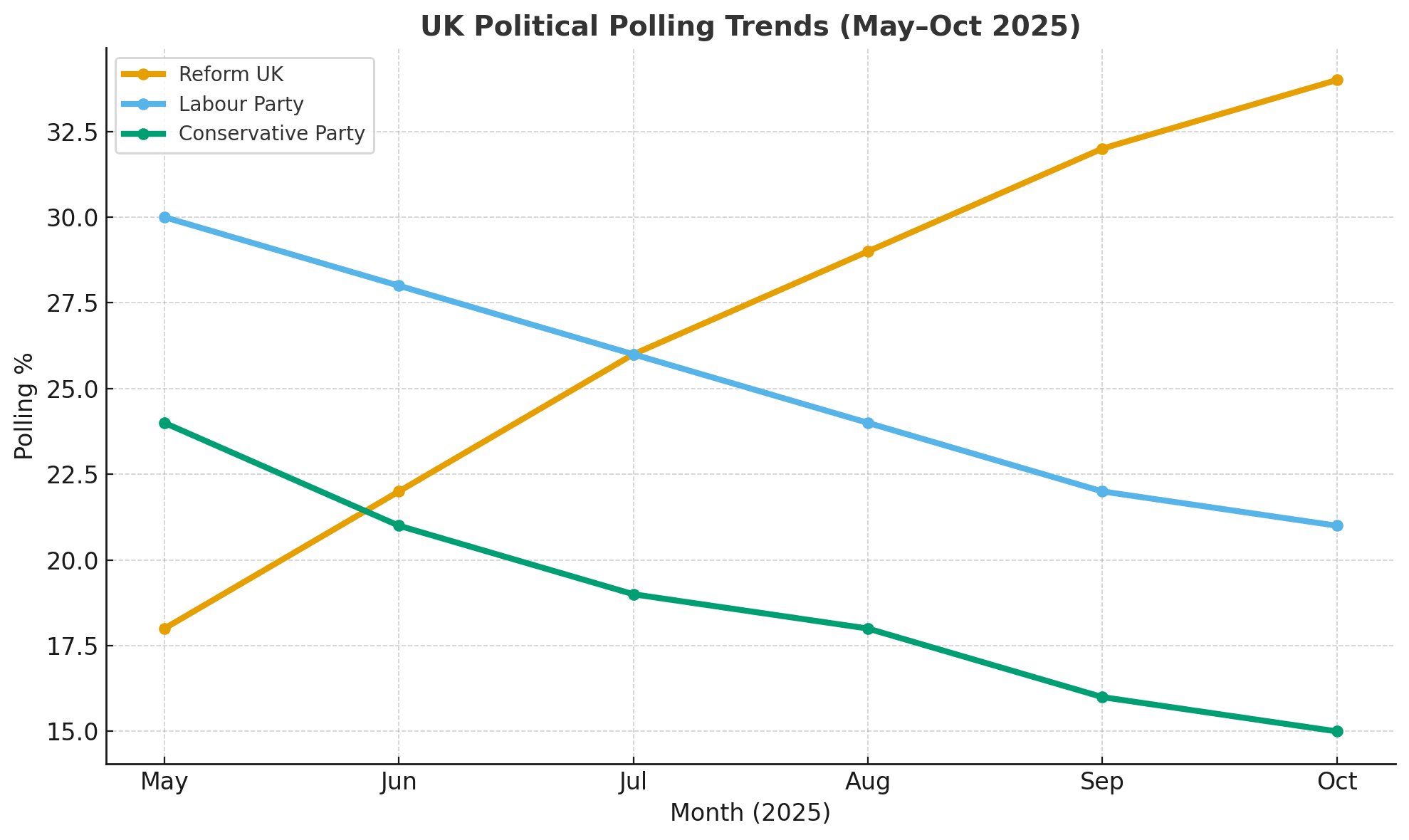
Across the anglicised world, traditional centre-right parties are struggling to hold their base. In Britain, Nigel Farage’s Reform UK has turned voter frustration into a movement that now leads national polls. In Australia, the Liberal–National Coalition has plunged to record-low primary support while Pauline Hanson’s One Nation steadily climbs. Both Farage and Hanson are tapping into the same discontent — economic stress, migration pressure, cultural fatigue, and anger at the political establishment — but they differ sharply in style, structure, and execution.
The Farage formula: populism with a well articulated vision
Nigel Farage has spent decades turning outsider energy into political leverage. In 2024, he finally broke through the barriers of Britain’s first-past-the-post system, winning his Clacton seat and entering the House of Commons. That victory transformed Reform UK from protest vehicle to parliamentary force — and it transformed Farage from talk-show crusader to legitimate political contender.
Recent polls underline that transformation:
- Ipsos (Oct 2025) places Reform UK at 34 per cent, ahead of both Labour (22 %) and the Conservatives (14 %).
- YouGov modelling suggests Reform could win the most seats if an election were held today.
- Support is concentrated in cost-of-living-hit regions, ex-industrial towns, and coastal communities — the same terrain that once powered Brexit.
Farage’s leadership style is key. He is sharp, disciplined, and rhetorically nimble — blending plain language with rhetoric that feels confident, witty, and strategic. He speaks from within the pub, not down from the pulpit. His mastery of broadcast and digital media (GB News, talk radio, TikTok) amplifies that tone.
Unlike many populists, Farage does not project chaos but clarity: he frames issues such as migration, energy, and sovereignty as rational policy debates, not emotional grievances. That combination, populist messaging with articulate delivery, explains why Reform UK now commands establishment attention rather than just protest headlines.
Pauline Hanson’s appeal — and its ceiling
Australia’s version of this insurgent mood is more fragmented. The Coalition’s primary vote has collapsed to around 27 per cent, its lowest in four decades (Newspoll, September 2025), while One Nation has lifted to 10–14 per cent across multiple surveys (Roy Morgan, Guardian Essential).
Yet Pauline Hanson’s leadership style remains both her asset and her limitation. As a Senator, she wields a national platform but not the same direct constituency power Farage now enjoys as a Member of Parliament. Her communication is plain-spoken, blunt, and emotional — resonating strongly in regional and outer-suburban Australia but often alienating moderate conservatives.
Hanson’s speeches mix genuine conviction with rhetorical volatility. She says what others won’t, yet her delivery often blurs message discipline with outrage. That rawness feeds authenticity among disaffected voters but makes coalition-building difficult. Where Farage calibrates his populism into a strategic narrative about national renewal, Hanson’s tone still leans toward protest over persuasion.
Two populisms, one frustration
| Feature | United Kingdom – Nigel Farage (Reform UK) | Australia – Pauline Hanson (One Nation) |
|---|---|---|
| Polling strength (past 6 months) | 30–34 % nationally (1st place in some polls) | 10–14 % nationally (steady rise) |
| Major-party impact | Conservatives collapsing to ~14 % primary | Coalition collapsing to ~27 % primary |
| Leader’s role | MP in House of Commons (Clacton) | Senator in Federal Parliament |
| Style | Articulate, disciplined, media-savvy, witty | Blunt, emotive, plain-spoken, often ranting |
| Core themes | Migration control, cost of living, sovereignty, anti-elite reform | Cost of living, migration caps, housing, “Canberra elites” |
| Perceived ceiling | First-past-the post electoral system, but on current projections this might only be a 'speed bump'. | Strong protest base but limited growth beyond 15 % |
Both Farage and Hanson are drawing from the same well: frustration with economic strain, mistrust of institutions, and a desire for leaders who speak plainly. But Farage’s precision contrasts with Hanson’s passion — one forsters a movement, the other vents sentiment.
Lessons for the mainstream right
The UK Conservative Party and Australia’s Liberal–National Coalition now face parallel dilemmas:
- Rebuilding credibility on economics and migration.
- Reconnecting rhetorically — moving beyond managerial language toward something that feels human, authentic and conviction-driven.
- Containing insurgent minor parties without dismissing their voters’ grievances.
Farage’s success shows how quickly a disciplined insurgency with a compelling leader can become a serious movement with organisational coherence. Hanson’s endurance shows that populist authenticity can also find a ready audience — but without structural or stylistic reform, it will struggle to turn a protest into a governing movement.
The broader picture
Both countries are testing whether populism can evolve into a credible movement. Farage now sits in Westminster, shaping the national debate from the inside. Hanson remains in the Senate, shaping it from the flanks. The future of centre-right politics, in their respective countries, is for the taking: articulate disruption versus angry authenticity.
If the UK’s example is any guide, Australia’s political right is heading for a reckoning — not just about policies, but about how its leaders speak to the nation.